
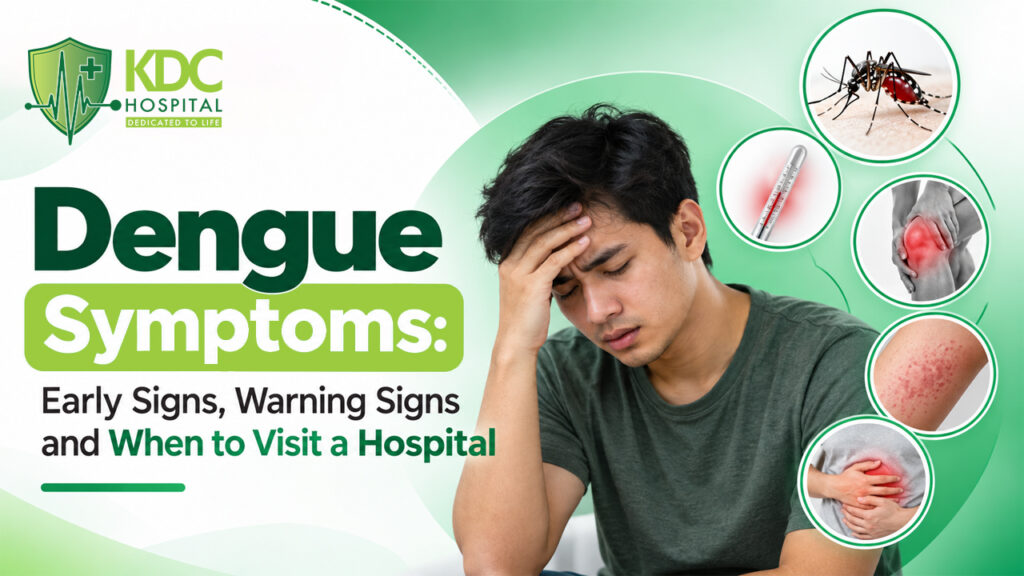
Dengue symptoms commonly include sudden fever, severe headache, pain behind the eyes, muscle or joint pain, nausea, vomiting and sometimes a skin rash. Most people recover, but some develop warning signs such as severe abdominal pain, persistent vomiting, bleeding, unusual drowsiness or restlessness, breathing difficulty or sudden worsening especially around the time the fever begins to fall.
If these warning signs appear, prompt medical assessment is important. Dengue cannot be confirmed reliably from symptoms or platelet count alone, and the most appropriate diagnostic test can depend on how many days the person has been ill.
This guide explains the early signs of dengue, the different phases of illness, severe dengue symptoms, dengue testing, platelet changes, basic supportive care and when someone should visit a hospital.
Content researched and updated: 10 September 2026
What Is Dengue?
Dengue is a viral infection caused by dengue virus and transmitted mainly through the bite of infected Aedes mosquitoes, particularly Aedes aegypti. These mosquitoes commonly bite during the daytime.
Many dengue infections cause no symptoms or only mild illness. When symptoms develop, WHO says they generally begin about 4–10 days after infection and typically last around 2–7 days. Common symptoms include fever, headache, pain behind the eyes, muscle and joint pain, nausea, vomiting, swollen glands and rash.
Most symptomatic patients recover without severe complications. A smaller proportion develop severe dengue, which can involve plasma leakage, serious bleeding, shock or organ involvement and requires prompt hospital care.
Why Is Dengue Relevant in Nepal Right Now?
Dengue is an established public-health concern in Nepal, and local context matters when evaluating unexplained fever.
Following flash floods in parts of central Nepal on 26 August 2026, the Government of Nepal and WHO strengthened surveillance for communicable diseases in affected communities. WHO reported on 9 September 2026 that diagnostic support included testing capacity for diseases such as dengue, malaria, scrub typhus, influenza A and B, and leptospirosis.
This does not mean that every fever during Nepal’s rainy or post-monsoon period is dengue.
That distinction is important.
Several infections can cause fever, weakness, headache, nausea or body pain. Assuming that every fever is dengue—and then relying only on a platelet count or a rapid test can delay appropriate assessment for another illness.
Nepal’s Epidemiology and Disease Control Division also maintains national dengue guidelines and dedicated dengue-control resources for prevention, diagnosis and case management.
For people in Kathmandu and elsewhere in Nepal, the practical approach is therefore:
recognize possible dengue symptoms, monitor for warning signs, and seek appropriate clinical evaluation rather than attempting to diagnose the illness from symptoms alone.
What Are the Early Signs of Dengue?
The early signs of dengue can resemble an ordinary viral illness, which is one reason diagnosis is sometimes difficult at the beginning.
The most common symptom is fever accompanied by one or more characteristic complaints.
Common dengue fever symptoms include:
- sudden high fever
- severe headache
- pain behind the eyes
- muscle pain
- joint or bone pain
- nausea
- vomiting
- tiredness or weakness
- swollen glands
- skin rash.
WHO lists high fever, severe headache, retro-orbital pain, muscle and joint pain, nausea, vomiting, swollen glands and rash among typical symptomatic presentations.
CDC similarly describes fever accompanied by headache, eye pain, muscle or joint pain, nausea, vomiting or rash as common clinical features.
Does Dengue Always Cause All These Symptoms?
No.
A person may have only a few symptoms. Another patient may experience much more intense body pain, vomiting or weakness.
Some people infected with dengue virus do not become noticeably ill at all. Because symptoms overlap with other infections, the absence of one “classic” feature such as eye pain or rash does not reliably rule dengue out.
Likewise, having fever plus severe body pain does not automatically confirm dengue.
The patient’s location, exposure history, illness duration, examination findings and, when appropriate, diagnostic testing all help clinicians make a more informed assessment.
What Does Dengue Fever Usually Feel Like?
For many patients, dengue begins abruptly rather than gradually.
A person may develop fever along with significant fatigue, headache and generalized muscle or joint pain. Pain behind the eyes also called retro-orbital pain is frequently associated with dengue.
Nausea and reduced appetite may make it harder to maintain fluid intake.
A rash may develop during the illness, although it is not present in every patient.
The practical challenge is that the first stage can resemble influenza and other febrile infections. That is why symptoms should be interpreted as a pattern rather than as a checklist that confirms a diagnosis.
What Are the Three Phases of Dengue?
Clinicians commonly describe symptomatic dengue in three phases:
- febrile phase;
- critical phase;
- recovery phase.
Understanding this progression is useful because the most dangerous period is not necessarily when the fever is highest.
| Phase | What may happen | What matters most |
|---|---|---|
| Febrile | Fever, headache, eye pain, muscle/joint pain, nausea, rash | Hydration, assessment and monitoring |
| Critical | Fever may fall while warning signs or plasma leakage can develop | Watch carefully for abdominal pain, vomiting, bleeding, lethargy and deterioration |
| Recovery | Clinical condition and appetite usually improve; blood counts recover over time | Continue follow-up as advised |
The exact timing and severity vary between patients.
1. Febrile Phase
The febrile phase is usually the period when fever and typical dengue symptoms are most noticeable.
The patient may experience:
- high temperature
- headache
- body aches
- eye pain
- nausea
- vomiting
- weakness
- rash.
At this stage, dengue may be difficult to distinguish clinically from other febrile illnesses.
A healthcare professional may consider the duration of fever, local epidemiology, other symptoms, hydration status, physical examination and appropriate investigations.
Stable patients without warning signs may often be managed without hospital admission, but they need clear instructions about what symptoms should trigger reassessment. CDC emphasizes educating outpatients about warning signs and when to return for medical care.
Patients with stable fever or suspected infection can seek evaluation through KDC Hospital’s Internal Medicine service or appropriate outpatient medical consultation at KDC Hospital.
2. Critical Phase: Why Falling Fever Can Be Misleading
One of the most important facts about dengue is this:
a lower temperature does not always mean the dangerous period has passed.
The critical phase often begins around defervescence, the period when the fever starts resolving. CDC guidance notes that careful monitoring is particularly important during this phase because warning signs or severe disease can emerge.
A family member may understandably think:
“The fever is normal now, so the patient is recovering.”
Often that is true.
But not always.
This is why changes in the patient’s overall condition matter more than the thermometer alone.
Someone whose temperature has improved but who develops severe abdominal pain, persistent vomiting, bleeding, unusual sleepiness, restlessness, breathing difficulty, cold skin or worsening weakness should be evaluated promptly.
3. Recovery Phase
Most patients eventually enter a recovery phase in which their general condition improves.
Appetite and energy may begin returning, hydration becomes easier to maintain, and laboratory abnormalities may gradually recover.
CDC notes that white blood cell counts often begin to rise before platelet recovery. WHO also notes that some people may experience fatigue for several weeks after dengue.
Feeling tired after the acute fever therefore does not necessarily mean the infection remains severe, but persistent or worsening symptoms should still be discussed with a healthcare professional.
What Are the Warning Signs of Severe Dengue?
Dengue warning signs indicate that a patient may be at greater risk of developing severe disease and should receive prompt medical assessment.
Important warning signs include:
- severe abdominal pain or tenderness
- persistent vomiting
- bleeding from the gums or nose
- blood in vomit
- blood in stool
- unusual drowsiness
- marked restlessness or irritability
- clinical evidence of fluid accumulation
- significant worsening as the fever falls.
WHO also lists rapid breathing, intense thirst, pale or cold skin and feeling very weak among severe symptoms requiring immediate care.
CDC’s clinical guidance includes abdominal pain, persistent vomiting, mucosal bleeding, altered mental status, fluid accumulation and other clinical or laboratory warning signs.
Why Do These Warning Signs Matter?
Severe dengue can involve leakage of fluid from blood vessels, shock, severe bleeding or significant organ involvement.
Those complications cannot be safely assessed from a home thermometer or platelet report alone.
Clinical assessment may involve blood pressure, pulse, circulation, hydration, urine output, mental status, abdominal examination and laboratory changes such as hematocrit.
If warning signs are present, appropriate hospital monitoring can become necessary.
When Should You Visit a Hospital for Dengue?
A person with suspected dengue should seek medical assessment when symptoms are persistent, worsening, difficult to manage safely at home or accompanied by warning signs.
Arrange medical evaluation if:
- fever continues or the cause is uncertain
- weakness is increasing
- the patient has repeated nausea or vomiting
- oral fluid intake is becoming difficult
- urine output appears to be decreasing
- symptoms are worsening rather than improving
- there is uncertainty about whether the illness is dengue or another infection
- the patient has relevant underlying medical conditions.
Seek urgent medical care when:
- severe abdominal pain develops
- vomiting becomes persistent
- nose or gum bleeding occurs
- there is blood in vomit or stool
- the patient becomes unusually drowsy, confused or restless
- breathing becomes difficult or unusually rapid
- the skin becomes pale or cold
- the person faints or appears to have circulatory collapse
- the patient’s general condition suddenly worsens as fever falls.
Severe dengue can be life-threatening and requires prompt medical care.
KDC Hospital lists 24/7 General Practice and Emergency Medicine services for patients requiring urgent medical assessment.
OPD or Emergency: Where Should a Patient Go?
A useful decision is whether the patient’s condition appears stable enough for outpatient assessment or whether emergency evaluation is more appropriate.
A patient with uncomplicated fever who is alert, drinking normally, urinating normally and has no warning signs may be suitable for OPD assessment.
A patient with severe pain, persistent vomiting, bleeding, breathing difficulty, fainting, altered consciousness or rapid deterioration should not wait for a routine outpatient appointment.
KDC’s existing OPD guidance similarly distinguishes stable conditions from severe or potentially life-threatening symptoms requiring emergency care.
How Is Dengue Diagnosed?
Dengue diagnosis involves more than checking one symptom or one laboratory number.
A clinician may consider:
- current symptoms
- how many days the patient has been ill
- physical examination
- hydration and circulation
- local dengue activity
- residence or recent travel
- previous medical conditions
- laboratory findings
- dengue-specific tests where appropriate.
Nepal’s national dengue guidelines describe clinical assessment, disease-phase assessment and laboratory investigation as parts of dengue evaluation and case management.
Because dengue resembles other febrile illnesses, laboratory testing can help confirm infection but test choice matters.
Which Dengue Test Is Best?
There is no single dengue test that performs identically throughout every stage of illness.
The day of illness affects which test is likely to provide useful information.
During the First 7 Days
CDC recommends acute-phase testing with either:
- a nucleic acid amplification test such as RT-PCR plus IgM or
- an NS1 antigen test plus IgM.
NS1 antigen and dengue viral RNA are generally most useful during the early acute phase.
After Day 7
After the acute phase, IgM antibody testing becomes more important.
CDC states that IgM is generally the primary recommended test after day seven, although interpretation can be affected by timing and cross-reactivity.
Why Timing Matters
This explains why statements such as:
“My dengue test was negative, so I definitely don’t have dengue”
can be misleading without knowing:
- which test was performed;
- when it was performed;
- how long symptoms had been present;
- what the clinical picture looked like.
A negative early NS1 or molecular result does not necessarily rule out dengue in every circumstance.
WHO’s 2025 laboratory guidance similarly emphasizes selecting dengue tests according to the stage of infection, local context, test performance and other clinical factors.
What Is an NS1 Dengue Test?
NS1 testing looks for non-structural protein 1, a dengue viral antigen that circulates in the blood during acute infection.
It is generally useful during the first several days of symptoms and is commonly considered an early-phase dengue test.
CDC states that NS1 antigen can be detectable during the first seven days of illness. A positive NS1 result supports acute dengue infection, while a negative result does not always exclude it.
The decision about what test to order should therefore be based on illness timing and clinical assessment rather than simply choosing the test name most commonly seen online.
What Is the Dengue IgM Test?
The IgM test looks for antibodies produced by the immune system in response to recent dengue infection.
These antibodies usually become more useful after several days of illness and are especially relevant when the acute phase has passed.
CDC notes that dengue IgM often becomes detectable around four to five days after symptom onset and can remain detectable for a period afterward.
Because antibody tests can sometimes cross-react with other related viruses, results should be interpreted in clinical context.
Does CBC Diagnose Dengue?
No. A complete blood count, or CBC, can provide useful clinical information, but it does not by itself confirm dengue infection.
CBC testing may show changes in:
- platelet count
- white blood cell count
- hematocrit.
CDC lists thrombocytopenia and leukopenia among laboratory findings that may occur in dengue.
However, similar laboratory abnormalities can occur for reasons other than dengue.
Doctors use CBC results as part of the overall clinical picture rather than as a standalone diagnostic answer.
KDC lists general medical and diagnostic services as part of its broader hospital setup. Patients who need evaluation can discuss appropriate investigations with a clinician rather than ordering or interpreting laboratory tests in isolation.
What Happens to Platelet Count in Dengue?
Platelet counts can decrease during dengue, particularly as the illness progresses.
This laboratory finding receives substantial attention because platelets contribute to normal blood clotting.
But one of the biggest misconceptions surrounding dengue is:
“The platelet number tells me exactly how serious the dengue is.”
It does not.
Doctors assess the entire patient.
Clinical warning signs, blood pressure and circulation, bleeding, hematocrit changes, hydration, urine output, mental status, organ involvement and the overall progression of illness can all be important.
Severe dengue is classified primarily around severe plasma leakage, severe bleeding or significant organ involvement—not solely around a particular platelet value.
Is There One Dangerous Platelet Number?
There is no single platelet number that should be interpreted by patients as a complete measure of dengue severity.
Two patients with the same platelet count may have very different clinical conditions.
Likewise, a patient should not assume that feeling well means laboratory follow-up is unnecessary if a clinician has advised monitoring.
The trend and overall clinical condition matter.
Do Low Platelets Mean You Need a Platelet Transfusion?
Not automatically.
Current CDC clinical guidance specifically states that prophylactic platelet transfusions are not recommended simply because platelet counts are low. Transfusion decisions depend on the patient’s clinical circumstances, including significant active bleeding and other findings.
This is an important reason not to make treatment decisions based on an isolated laboratory report.
Only the treating medical team can determine whether transfusion or another intervention is appropriate for an individual patient.
What Is the Treatment for Dengue?
There is currently no specific antiviral treatment that cures dengue.
Management is primarily supportive and depends on the severity of illness.
WHO recommends rest, adequate fluid intake, appropriate fever/pain management and careful observation for severe symptoms.
Stable patients may be managed outside the hospital when clinically appropriate.
Patients with warning signs, significant coexisting medical conditions, inability to maintain oral fluids or severe dengue may require inpatient care.
What Can You Do at Home During Mild Dengue?
Home care should only be used when the patient is clinically suitable for outpatient management and understands the warning signs.
General supportive measures commonly include:
- adequate rest
- maintaining oral fluid intake
- monitoring for worsening symptoms
- following the healthcare professional’s instructions
- returning for follow-up or repeat testing if advised.
Oral fluid intake is important because fever, reduced appetite and vomiting can contribute to dehydration.
However, patients should not force excessive fluid intake or start intravenous fluids themselves. Fluid requirements vary according to age, health condition, severity and clinical status.
Which Painkillers Should Be Avoided in Dengue?
WHO advises avoiding aspirin and non-steroidal anti-inflammatory drugs such as ibuprofen in dengue because these medicines can increase bleeding risk.
Paracetamol/acetaminophen is generally used for fever and pain when medically appropriate.
Medication dosing depends on factors such as age, body weight, existing health conditions and other medicines.
Parents should be particularly careful not to estimate children’s medication doses without appropriate guidance.
Does Papaya Leaf Juice Increase Platelets?
Papaya leaf juice and other home remedies are widely discussed in communities and online, but they should not be treated as substitutes for clinical evaluation, hydration, monitoring or evidence-based dengue management.
The clinically important question is not:
“What food can raise my platelets fastest?”
It is:
“Is the patient’s overall condition stable, are warning signs developing, and does medical monitoring need to be intensified?”
A person with severe abdominal pain, persistent vomiting, bleeding or signs of circulatory deterioration needs medical care—not reliance on a home remedy.
What Should a Person Eat During Dengue?
There is no special food that cures dengue.
When a person can eat normally, meals should generally focus on tolerable nutrition and adequate fluids.
Someone experiencing nausea may find smaller, more frequent meals easier than large meals.
The more important concern is whether the person:
- can drink adequately;
- continues passing urine;
- can keep fluids down;
- is becoming increasingly weak;
- is developing warning signs.
Persistent vomiting or inability to maintain hydration should prompt medical evaluation.
Who May Need Closer Monitoring?
Some patients may require closer clinical observation even before classic warning signs develop.
CDC clinical guidance identifies circumstances that can affect management decisions, including pregnancy, significant kidney disease, bleeding disorders, difficulty tolerating oral fluids and several chronic medical conditions. Age and reliable access to healthcare can also influence whether outpatient care is appropriate.
The important point is that dengue management should be individualized.
Someone with diabetes, hypertension, kidney disease, liver disease, pregnancy or another significant medical condition should inform the treating clinician.
Can Children Get Severe Dengue?
Yes.
Children can develop dengue and severe dengue.
Parents should pay attention not only to fever but also to behavior, alertness, drinking, urination, persistent vomiting, abdominal pain, bleeding and marked changes in activity.
A child who appears unusually sleepy, difficult to wake, severely weak, unable to drink or significantly worse should receive medical assessment promptly.
Medication should also be given according to age- and weight-appropriate professional guidance.
Can You Get Dengue More Than Once?
Yes.
There are four dengue virus serotypes, meaning infection with one type does not provide complete lifelong protection against all others.
WHO notes that a previous dengue infection can increase the risk of severe disease with a later infection.
Therefore, a person who previously had dengue should not dismiss a new episode of fever as impossible.
Can Dengue Spread Directly From Person to Person?
Dengue is primarily transmitted through infected mosquitoes rather than ordinary casual contact between people.
A mosquito can become infected after biting a person carrying dengue virus and later transmit the virus through another bite.
WHO notes that infected people can transmit the virus to mosquitoes around the period of illness, including shortly before symptoms and for a period after fever resolves.
This is one reason mosquito-bite prevention remains useful even after a person becomes ill.
How Can Dengue Be Prevented?
The most effective everyday prevention strategy is reducing exposure to mosquitoes and limiting mosquito breeding sites.
Aedes mosquitoes that transmit dengue are active during the day, so mosquito protection should not be limited to nighttime.
Reduce Mosquito Breeding Around the Home
Regularly inspect places where water can accumulate, including:
- buckets
- water-storage containers
- discarded bottles
- flower pots and trays
- tires
- rooftop containers
- drains
- outdoor household objects.
WHO recommends covering, emptying and cleaning water-storage containers regularly and removing artificial containers capable of holding water.
Nepal’s EDCD also maintains dengue-control resources specifically focused on finding and destroying mosquito breeding habitats.
Reduce Mosquito Bites
WHO recommends protective measures such as:
- clothing that covers more of the body
- appropriate mosquito repellents
- window screens
- mosquito nets when sleeping during the day
- suitable mosquito-control products.
Prevention is particularly important around a household where someone already has dengue because preventing additional mosquito bites can help interrupt further mosquito-mediated transmission.
Common Dengue Mistakes to Avoid
Several behaviors can make dengue harder to manage safely.
Assuming every fever is dengue
Other infections can produce similar symptoms. Clinical assessment matters.
Assuming a negative early test permanently rules dengue out
Diagnostic accuracy depends partly on which test was performed and when.
Watching only the platelet count
Platelets are important, but severity assessment requires much more than one number.
Assuming the patient is safe because fever has disappeared
The critical phase can begin around defervescence.
Taking ibuprofen or aspirin without appropriate advice
These medicines may increase bleeding risk in dengue.
Waiting at home despite warning signs
Severe abdominal pain, persistent vomiting, bleeding, altered consciousness, breathing difficulty or sudden deterioration should prompt urgent assessment.
Depending on home remedies instead of monitoring
Food and fluids can support recovery, but they cannot replace medical care when severe symptoms develop.
Dengue Symptoms in Nepal: Why Clinical Assessment Matters
Nepal’s current disease-surveillance context illustrates an important point: fever requires differential diagnosis.
As of 9 September 2026, WHO reported post-flood diagnostic support in Nepal for dengue as well as malaria, scrub typhus, influenza A/B and leptospirosis.
Therefore, the safest SEO message and the safest patient message is not:
“You have these symptoms, therefore you have dengue.”
It is:
“These symptoms can occur with dengue. A healthcare professional can assess whether dengue or another illness is more likely and determine whether testing or monitoring is needed.”
This distinction improves both medical accuracy and trustworthiness.
When to Consider KDC Hospital for Fever or Suspected Dengue
Someone with persistent fever, significant body pain, nausea, vomiting, unusual weakness or possible dengue symptoms can seek clinical evaluation rather than relying solely on self-diagnosis.
KDC Hospital’s Internal Medicine department supports adult medical assessment, including acute illnesses and infections, while KDC OPD services provide outpatient consultation for stable conditions.
Patients with dengue warning signs or rapid deterioration should seek urgent medical attention. KDC’s General Practice and Emergency Medicine department lists 24/7 emergency availability and medical triage.
Patients and families can also view KDC Hospital’s doctor roster or contact KDC Hospital directly for current service and appointment information.
Key Takeaways
Dengue commonly causes fever accompanied by headache, pain behind the eyes, body or joint pain, nausea, vomiting, weakness or rash.
Most cases improve without severe complications.
The most important period to watch carefully may occur as the fever begins to fall, when warning signs can emerge.
Severe abdominal pain, persistent vomiting, bleeding, marked restlessness or drowsiness, breathing difficulty, cold or pale skin, or rapid deterioration require prompt medical attention.
Dengue diagnosis should not rely on symptoms or platelet count alone. The usefulness of tests such as NS1, molecular testing and IgM depends partly on the stage of illness.
Most importantly:
Treat the patient, not just the thermometer or platelet number.
Frequently Asked Questions
What Are the First Symptoms of Dengue?
The first symptoms commonly include sudden fever, headache, pain behind the eyes, muscle or joint pain, nausea, vomiting, weakness and sometimes rash. Symptoms usually begin several days after infection. Because early dengue can resemble many other febrile illnesses, symptoms alone cannot reliably confirm the diagnosis.
How Many Days Does Dengue Fever Last?
Symptomatic dengue commonly causes fever and other symptoms for around 2–7 days, although recovery varies between patients. Some people continue experiencing tiredness after the acute illness. The disappearance of fever should not be used alone to decide that dengue has fully resolved because warning signs can appear around this transition.
What Are the Dangerous Symptoms of Dengue?
Important danger signs include severe abdominal pain, persistent vomiting, bleeding from the nose or gums, blood in vomit or stool, marked drowsiness or restlessness, rapid breathing, pale or cold skin and significant deterioration. These symptoms should prompt urgent medical evaluation.
Is Dengue More Dangerous When the Fever Goes Down?
It can be. The critical phase of dengue often occurs around the time fever resolves. Most patients recover normally, but warning signs can develop during this period. Therefore, patients should continue monitoring their overall condition even when the temperature returns to normal.
Does Low Platelet Count Confirm Dengue?
No. Dengue can cause a reduction in platelet count, but thrombocytopenia can occur with other illnesses as well. Doctors interpret platelet levels together with symptoms, examination findings, hematocrit, circulation and other investigations. Dengue-specific laboratory testing may be necessary when confirmation is clinically appropriate.
What Platelet Count Is Dangerous in Dengue?
A single platelet number does not independently determine dengue severity. Doctors assess bleeding, plasma leakage, circulation, hematocrit, organ involvement and the patient’s overall condition. Treatment or transfusion decisions should therefore not be made from an isolated platelet result.
Does a Dengue Patient Always Need Hospital Admission?
No. Stable patients without warning signs may often be managed as outpatients when they can drink adequately, have normal urine output and have appropriate follow-up. Patients with warning signs, severe dengue or certain significant health conditions may require hospital management.
When Should I Take an NS1 Test for Dengue?
NS1 antigen testing is generally most useful during the acute phase, particularly within the first seven days of symptoms. Test selection should still depend on the clinical situation and day of illness. A negative NS1 result does not always completely exclude dengue.
When Should Dengue IgM Be Tested?
Dengue IgM becomes more useful after several days of illness and is generally the main serological test after the first week. CDC notes that IgM often becomes detectable around four to five days after symptom onset. Results should be interpreted alongside symptoms and other investigations.
Can Dengue Be Treated at Home?
Some uncomplicated dengue cases can be managed outside the hospital with medical guidance, rest, fluids and careful monitoring. Home management is inappropriate when warning signs develop, oral hydration becomes difficult, the patient deteriorates or a clinician determines that closer monitoring is needed.
What Medicine Is Used for Dengue Fever?
There is no specific antiviral treatment that cures dengue. Paracetamol/acetaminophen is generally used for fever or pain when medically appropriate. WHO advises avoiding aspirin and NSAIDs such as ibuprofen because they can increase bleeding risk.
Can You Get Dengue Twice?
Yes. Dengue virus has multiple serotypes, so previous infection does not prevent every future dengue infection. WHO notes that people experiencing a subsequent dengue infection may have a greater risk of severe disease.
Is Dengue Contagious From Person to Person?
Dengue is mainly spread when infected Aedes mosquitoes transmit dengue virus between people. Ordinary casual contact is not the usual route of transmission. Preventing mosquito bites around an infected person remains important because mosquitoes can acquire the virus and later infect others.
How Long Does It Take to Recover From Dengue?
Many people begin recovering within one to two weeks, although the exact course varies. Fatigue may continue for several weeks in some patients. Anyone whose condition worsens instead of improving should receive medical assessment.