
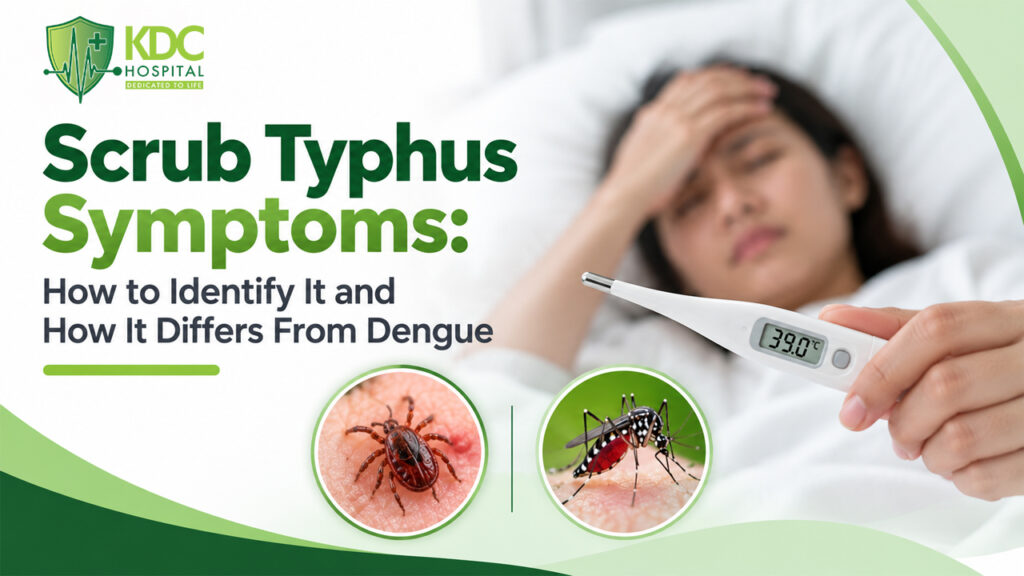
Scrub typhus symptoms commonly include fever, chills, headache, muscle or body pain and sometimes rash, swollen lymph nodes or a dark scab-like skin lesion known as an eschar. The infection is caused by the bacterium Orientia tsutsugamushi and spreads through bites from infected chiggers, larval mites.
Scrub typhus can resemble dengue, especially during the early stages when both illnesses may cause fever, headache, body pain and changes in blood counts. An eschar can strongly suggest scrub typhus when present, but many patients never develop an obvious one.
Early medical evaluation matters because scrub typhus is a bacterial infection that can respond to appropriate antibiotics, whereas dengue is a viral illness managed differently.
What Is Scrub Typhus?
Scrub typhus, sometimes called bush typhus, is an acute infectious disease caused by the bacterium Orientia tsutsugamushi.
Humans become infected when they are bitten by infected chiggers, the larval stage of certain trombiculid mites.
According to the CDC overview of scrub typhus, common symptoms include fever, chills, headache, body aches, enlarged lymph nodes, rash and, in some patients, an eschar at the site of the chigger bite.
Scrub typhus is found predominantly in parts of Asia and the Pacific, including the Indian subcontinent.
WHO Nepal has specifically identified scrub typhus as a vector-borne disease relevant to Nepal and has supported training of healthcare workers in its diagnosis, management, prevention and control. WHO Nepal’s scrub typhus information
Is Scrub Typhus Common in Nepal?
Scrub typhus is an established cause of acute febrile illness in Nepal and continues to be included in national disease surveillance.
Nepal’s Epidemiology and Disease Control Division includes scrub typhus within its surveillance system, and 2026 surveillance bulletins continue to report scrub typhus alongside other communicable diseases. For example, the national Week 17 surveillance bulletin recorded 27 scrub typhus cases reported through the surveillance system during that epidemiological week. Nepal EDCD’s 2026 surveillance data
Longer-term Nepal research also shows why clinicians consider scrub typhus in patients with unexplained fever.
A systematic review of 15 Nepal studies involving 10,977 participants found scrub typhus represented an important share of acute undifferentiated febrile illnesses in the populations studied. The studies showed seasonal concentration around the monsoon and post-monsoon period, although the authors emphasized geographic and study-level variation. systematic review of scrub typhus in Nepal
These historical research figures should not be interpreted as Nepal’s current national prevalence. They instead demonstrate that scrub typhus is an established differential diagnosis for unexplained fever in Nepal.
What Are the Main Scrub Typhus Symptoms?
The most typical scrub typhus symptoms are fever, headache and body or muscle pain. Other patients may develop rash, swollen lymph nodes, cough, nausea, abdominal symptoms or an eschar.
According to CDC clinical guidance on scrub typhus, the illness can range from relatively mild disease to severe infection involving multiple organs.
Common symptoms and signs include:
- fever;
- chills;
- headache;
- muscle pain;
- generalized body aches;
- rash;
- swollen lymph nodes;
- an eschar;
- fatigue or weakness;
- nausea or other gastrointestinal symptoms in some patients.
Symptoms often begin several days after infection.
CDC describes symptom onset as usually occurring around 7–10 days after infection, while Nepal’s infectious-disease guidance describes an incubation period that may range more broadly.
The exact presentation differs substantially between patients.
What Does Scrub Typhus Fever Feel Like?
Scrub typhus generally causes an acute febrile illness, meaning fever may begin relatively suddenly and can occur with headache, chills and body pain.
The problem is that this pattern is not unique to scrub typhus.
Dengue, influenza, enteric fever, leptospirosis and other infections may produce similar early symptoms.
A clinician therefore considers not only fever but also:
- duration of illness;
- outdoor or vegetation exposure;
- skin examination;
- presence or absence of an eschar;
- rash or enlarged lymph nodes;
- respiratory symptoms;
- blood tests;
- local disease activity;
- other possible causes of fever.
This is why scrub typhus should not be diagnosed simply because fever occurs during the monsoon season.
What Is an Eschar in Scrub Typhus?
An eschar is a dark, scab-like skin lesion that can form at the site where an infected chigger transmitted scrub typhus. When found in a patient with compatible fever, it can be an important diagnostic clue.
The lesion develops where the organism is introduced into the skin.
The CDC clinical description of scrub typhus eschar notes that eschars may be found in less obvious areas such as the armpit, under the breast or in the groin, as well as on the abdomen, back or limbs.
Because an eschar may be hidden beneath clothing or within skin folds, a careful clinical examination may be necessary.
What Does an Eschar Look Like?
An eschar commonly appears as a localized lesion with a dark or black central crust.
The appearance can resemble a healing wound or scab.
It should not be confused with every dark skin lesion, insect bite or ordinary wound.
CDC’s Emerging Infectious Diseases journal explains that an eschar develops at the site where certain rickettsial pathogens are introduced by feeding mites or ticks. CDC’s clinical explanation of an eschar
Can You Have Scrub Typhus Without an Eschar?
Yes. The absence of an eschar does not rule out scrub typhus.
This point is particularly important in Nepal.
A systematic review of laboratory-confirmed scrub typhus studies from Nepal found documented eschars in only 7.84% of the Nepalese cases included in the analysis. The authors noted substantial variation across studies. Nepal scrub typhus systematic review
A separate Kathmandu referral-hospital study similarly found eschar in a minority of scrub typhus patients.
Therefore:
eschar present → valuable clue
but
eschar absent → scrub typhus still possible
That distinction can help prevent delayed diagnosis.
Scrub Typhus Is Caused by Which Insect?
This common search query contains a small medical misconception.
Scrub typhus is not transmitted by an insect. It is transmitted by infected chiggers, which are the larval stage of trombiculid mites.
Mites are arachnids rather than insects.
Humans are infected when an infected chigger bites and feeds on the skin.
The CDC scrub typhus transmission guidance specifically identifies infected chiggers as the vector.
Scrub typhus is therefore often associated with environments where these mites and their animal hosts are present, including areas containing grasses, scrub vegetation and agricultural land.
Who May Be More Exposed to Scrub Typhus?
Exposure risk tends to be greater when people spend time in areas where infected chiggers are present.
Nepal’s communicable-disease guidance identifies groups such as agricultural workers and people exposed to shrubs, bushy environments or outdoor activities as potentially more exposed. Nepal’s infectious-disease guidance on scrub typhus
Possible exposure scenarios include:
- farming;
- working in fields;
- sitting directly on grass;
- clearing vegetation;
- trekking or camping;
- spending prolonged time in scrubby rural environments.
Exposure does not mean infection is inevitable.
Likewise, patients should not dismiss scrub typhus simply because they do not remember being bitten the mites are extremely small and the bite may go unnoticed.
Scrub Typhus vs Dengue: What Is the Difference?
Scrub typhus and dengue can initially look similar because both may cause fever, headache, weakness, body pain and abnormal blood counts. The major difference is that scrub typhus is a bacterial infection transmitted by chiggers, while dengue is a viral infection transmitted by Aedes mosquitoes.
That difference has major implications for diagnosis and treatment.
| Feature | Scrub Typhus | Dengue |
|---|---|---|
| Cause | Orientia tsutsugamushi bacterium | Dengue virus |
| Main vector | Chigger/larval mite | Aedes mosquito |
| Fever | Common | Common |
| Headache | Common | Common |
| Body/muscle pain | Common | Common |
| Rash | Can occur | Can occur |
| Eschar | Strong clue when present | Not typical |
| Low platelets | Can occur | Can occur |
| Antibiotics | Used for scrub typhus | Do not treat dengue |
| Main treatment approach | Appropriate antibiotic + supportive care | Supportive management and monitoring |
| Diagnostic approach | Clinical assessment + serology/PCR where appropriate | Dengue-specific tests based on illness stage |
The table helps highlight patterns, but it cannot diagnose an individual patient.
Why Are Scrub Typhus and Dengue Easy to Confuse?
Both diseases can occur in regions of South Asia and may circulate during overlapping seasons.
Both can cause:
- fever;
- headache;
- muscle aches;
- weakness;
- nausea;
- rash;
- low platelet counts;
- elevated liver enzymes in some cases.
A peer-reviewed study specifically examining the clinical differentiation of scrub typhus and dengue found considerable overlap between the two illnesses at presentation. peer-reviewed comparison of scrub typhus and dengue
Nepalese medical literature has also documented patients with both infections simultaneously, making the diagnostic picture even more complex.
For patients, the practical message is simple:
Do not diagnose scrub typhus or dengue from one symptom or platelet count alone.
Does an Eschar Mean It Is Scrub Typhus Rather Than Dengue?
An eschar in the right clinical setting strongly raises suspicion for scrub typhus and is not a characteristic dengue feature.
However, the reverse is not true.
No eschar does not mean the patient has dengue instead.
Because an eschar may be absent or overlooked particularly in Nepalese patients doctors must consider the entire clinical presentation and appropriate testing.
Can Platelet Count Differentiate Scrub Typhus From Dengue?
Not reliably.
Thrombocytopenia, or a reduced platelet count, can occur in both illnesses.
CDC clinical guidance notes thrombocytopenia among laboratory abnormalities seen with scrub typhus.
Dengue also commonly affects platelet counts.
Therefore, a patient with fever and low platelets cannot safely conclude:
“Low platelets mean I have dengue.”
Doctors may interpret platelet trends together with:
- white blood cell count;
- liver-function results;
- clinical examination;
- bleeding;
- hydration;
- respiratory findings;
- exposure history;
- appropriate disease-specific testing.
Can Scrub Typhus and Dengue Occur Together?
Yes, co-infection has been reported.
Published Nepalese cases and pediatric case series have documented dengue and scrub typhus occurring simultaneously. Nepalese research on dengue and scrub typhus co-infection
This is one more reason clinicians may broaden the investigation when symptoms, laboratory findings or disease progression do not fit a straightforward diagnosis.
How Is Scrub Typhus Diagnosed?
Scrub typhus diagnosis is based on clinical assessment, exposure context and laboratory testing when available. No single symptom including eschar should be used alone to diagnose or exclude the infection.
A doctor may evaluate:
- fever duration;
- headache and muscle pain;
- rash;
- enlarged lymph nodes;
- eschar;
- exposure to vegetation or outdoor environments;
- blood count;
- liver and kidney function where clinically indicated;
- scrub typhus-specific testing.
The CDC clinical guidance for diagnosing scrub typhus explains that serological tests are commonly used, while PCR-based testing can detect Orientia DNA in specimens such as blood or material from an eschar.
What Is the Scrub Typhus IgM Test?
An IgM test looks for antibodies that the immune system produces in response to infection.
IgM ELISA is commonly used in endemic settings to support the diagnosis of scrub typhus.
However, antibody tests have limitations.
Antibodies may not become detectable immediately at the beginning of the illness, and background antibody levels or testing methods can affect interpretation.
Consequently, doctors interpret a test result alongside the patient’s symptoms and duration of illness.
Nepal’s infectious-disease guidance also incorporates serology and molecular testing into scrub typhus case definitions. Nepal EDCD infectious-disease guidance
Can PCR Diagnose Scrub Typhus?
PCR can detect genetic material from Orientia tsutsugamushi and can provide specific evidence of infection when appropriate specimens and testing facilities are available.
CDC notes that molecular techniques can use whole blood, eschar swabs or tissue samples.
Availability varies considerably between healthcare systems and laboratories.
The treating doctor should therefore decide which investigation is appropriate rather than patients attempting to select a diagnostic test solely from an online symptom list.
Is the Weil-Felix Test Reliable for Scrub Typhus?
Older testing methods such as Weil-Felix have historically been used for rickettsial infections, particularly where modern diagnostics were unavailable.
However, CDC states that Weil-Felix testing has very low sensitivity and specificity and is not recommended as a diagnostic assay for scrub typhus. CDC diagnostic guidance on scrub typhus
Where more appropriate serological or molecular testing is available, clinicians generally prefer those approaches.
What Is the Treatment for Scrub Typhus?
Scrub typhus is treated with appropriate antibiotics prescribed by a healthcare professional. Early treatment is important because untreated disease can progress to serious complications.
CDC identifies doxycycline as the treatment of choice for suspected scrub typhus in many patients. CDC scrub typhus treatment guidance
Nepal’s national antimicrobial treatment guidelines also include doxycycline and alternative antibiotic strategies depending on factors such as age, severity and clinical situation. Nepal National Antimicrobial Treatment Guidelines
Patients should not self-start antibiotics based only on symptoms.
The appropriate antibiotic, route, duration and alternatives depend on factors including:
- age;
- pregnancy;
- allergy history;
- severity of disease;
- other illnesses;
- organ involvement;
- diagnostic uncertainty.
Can Scrub Typhus Be Cured?
Yes. Scrub typhus is generally treatable, particularly when recognized and treated appropriately.
CDC notes that people treated early with appropriate antibiotic therapy usually recover quickly.
The risk increases when treatment is delayed and severe complications develop.
This makes unexplained persistent fever especially with compatible exposure or an eschar worth medical evaluation rather than prolonged self-treatment at home.
Can Scrub Typhus Go Away Without Treatment?
Some infections may vary in clinical severity, but patients should not rely on scrub typhus resolving without treatment.
Untreated infection can progress to significant complications.
The CDC clinical overview of scrub typhus complications describes potential severe manifestations including acute respiratory distress, encephalitis, pneumonia, kidney or liver failure, bleeding and multi-organ dysfunction.
Because effective antibiotic therapy is available, waiting for suspected scrub typhus to “cure itself” can introduce unnecessary risk.
What Complications Can Scrub Typhus Cause?
Severe scrub typhus can affect multiple organ systems.
Potential complications include:
- pneumonia;
- acute respiratory distress;
- encephalitis or other neurological involvement;
- acute kidney injury;
- hepatitis or liver dysfunction;
- cardiovascular involvement;
- shock;
- multi-organ dysfunction.
A systematic review focused on Nepal found kidney, respiratory, cardiac and neurological complications among reported scrub typhus cases in the included studies. Nepal evidence on scrub typhus complications
These complications are one reason persistent fever should not be ignored when a patient’s condition is worsening.
What Are the Danger Signs That Need Urgent Medical Attention?
Seek urgent medical evaluation when fever is accompanied by significant deterioration, including:
- difficulty breathing;
- confusion or reduced consciousness;
- seizures;
- severe weakness;
- low blood pressure or fainting;
- persistent vomiting;
- jaundice;
- greatly reduced urine output;
- severe dehydration;
- signs of organ dysfunction.
These symptoms do not automatically mean scrub typhus, but they can indicate serious illness that should not wait for routine outpatient care.
KDC Hospital lists 24/7 General Practice and Emergency Medicine services for patients requiring urgent evaluation.
When Should You See a Doctor for Possible Scrub Typhus?
Consider medical evaluation when:
- fever persists without a clear explanation;
- fever occurs after significant outdoor or field exposure;
- an eschar-like skin lesion is found;
- symptoms continue to worsen;
- there is persistent headache or marked body pain;
- blood tests show unexplained abnormalities;
- fever is accompanied by rash, breathing problems or unusual weakness.
Stable patients can generally start with an appropriate outpatient or Internal Medicine assessment.
KDC Hospital’s Internal Medicine department manages adult acute and infectious illnesses, while KDC OPD services provide outpatient evaluation for patients who do not require emergency care.
How Can Scrub Typhus Be Prevented?
There is currently no routinely used vaccine for scrub typhus prevention, so reducing exposure to infected chiggers is important.
The CDC scrub typhus prevention recommendations advise avoiding heavily vegetated areas where possible and using appropriate protective clothing and repellents during exposure.
Practical steps can include:
- wearing long trousers and long sleeves;
- using suitable insect or arthropod repellents according to instructions;
- avoiding sitting or lying directly on grassy or scrub-covered ground;
- using a ground sheet when appropriate;
- reducing unnecessary exposure to dense vegetation;
- changing and washing clothing after prolonged outdoor exposure.
Nepal’s EDCD scrub typhus prevention guidance similarly emphasizes protective clothing, avoiding direct contact with bare ground and vegetation management. Nepal EDCD scrub typhus prevention guidance
Common Mistakes to Avoid With Scrub Typhus
Assuming every monsoon fever is dengue
Scrub typhus and several other infections can cause similar febrile illness.
Looking only for an eschar
An eschar is valuable when present, but Nepal studies show that many confirmed patients do not have a documented eschar.
Assuming low platelets automatically mean dengue
Scrub typhus can also cause thrombocytopenia.
Waiting for laboratory confirmation while becoming seriously ill
Diagnostic interpretation belongs with the treating clinician, especially when severe symptoms are developing.
Self-starting antibiotics
The medicine, dosage, duration and alternative treatment depend on patient-specific factors.
Stopping medical follow-up as soon as fever improves
Clinical recovery and treatment duration should be determined according to the treating doctor’s plan.
Scrub Typhus vs Dengue: The Most Important Takeaway
The two illnesses overlap enough that symptoms alone can mislead patients.
A useful framework is:
Eschar + compatible fever
→ raises suspicion for scrub typhus.
No eschar
→ does not exclude scrub typhus.
Low platelets
→ can occur with both diseases.
Dengue test positive
→ does not mean other infection is impossible when the clinical picture is unusual.
Persistent or worsening fever
→ deserves appropriate medical evaluation.
The goal is not to guess the infection from a checklist. It is to recognize when the pattern requires clinical assessment and appropriate testing.
Scrub Typhus Care at KDC Hospital
People experiencing persistent fever, headache, body pain, unexplained weakness, rash or another possible infectious illness can seek evaluation through KDC Hospital’s Internal Medicine service.
Stable patients may use KDC Hospital’s OPD service, while those experiencing serious deterioration, breathing problems, altered consciousness or other severe symptoms should seek urgent medical care.
Patients can review KDC Hospital’s doctors or contact KDC Hospital for current appointment and service information.
Key Takeaways
Scrub typhus is a bacterial infection caused by Orientia tsutsugamushi and transmitted by infected chiggers.
Common symptoms include fever, headache, body pain and sometimes rash, swollen lymph nodes or an eschar.
An eschar is a valuable clue, but many patients particularly in Nepal studies do not have an obvious one.
Scrub typhus and dengue can both cause fever, body pain and reduced platelet counts, so they cannot always be distinguished at home.
Scrub typhus is treatable with appropriate antibiotics, making early recognition and medical evaluation particularly important when fever persists or symptoms worsen.
Frequently Asked Questions
What is the main cause of scrub typhus?
Scrub typhus is caused by the bacterium Orientia tsutsugamushi. People acquire the infection through bites from infected chiggers, which are the larval stage of trombiculid mites. Chiggers are mites, not insects. CDC information on the cause and transmission of scrub typhus
What is the treatment of scrub typhus?
Scrub typhus is treated with appropriate antibiotics prescribed by a doctor. Doxycycline is widely recognized as a first-line treatment, while alternatives may be chosen for particular patients or clinical situations. Patients should not self-prescribe antibiotics because treatment selection and duration depend on age, pregnancy, severity, allergies and other factors.
What are the causes of typhus?
“Typhus” describes several different bacterial diseases. Scrub typhus is caused by Orientia tsutsugamushi and spread by chiggers; epidemic typhus is caused by Rickettsia prowazekii and associated with body lice; flea-borne or murine typhus is caused by Rickettsia typhi and spread through infected fleas. CDC overview of the different typhus fevers
What is the best treatment for typhus?
Treatment depends on the specific type of typhus, so the disease should first be clinically identified. For scrub typhus, doxycycline is commonly recommended, with alternative treatment considered in some situations. A doctor should choose the antibiotic and duration based on the individual patient and applicable clinical guidelines.
Can scrub typhus be cured on its own?
It is not safe to rely on scrub typhus resolving without treatment. Untreated infection can progress to serious complications involving the lungs, brain, kidneys, liver or multiple organs. Effective antibiotic treatment is available, and early treatment is associated with faster recovery.
How is scrub typhus diagnosed?
Doctors diagnose scrub typhus using the clinical pattern, exposure history, physical examination and laboratory testing where available. IgM or other serological tests are commonly used, while PCR can detect Orientia DNA in certain specimens. Test results need to be interpreted alongside the timing and clinical features of the illness.
Is scrub typhus contagious?
Scrub typhus is not typically spread through ordinary person-to-person contact. Humans mainly become infected through bites from infected chiggers.
Can scrub typhus reduce platelet count?
Yes. Thrombocytopenia can occur with scrub typhus, but low platelets are not specific to the disease. Dengue and several other illnesses can also lower platelet counts, so the result should be interpreted alongside symptoms and other tests.
How is scrub typhus different from dengue?
Scrub typhus is a bacterial infection transmitted by chiggers and can be treated with appropriate antibiotics. Dengue is a viral infection transmitted by Aedes mosquitoes and is managed mainly through supportive care and monitoring. Fever, headache, body pain and low platelets can occur in both, so medical evaluation may be needed to distinguish them.