
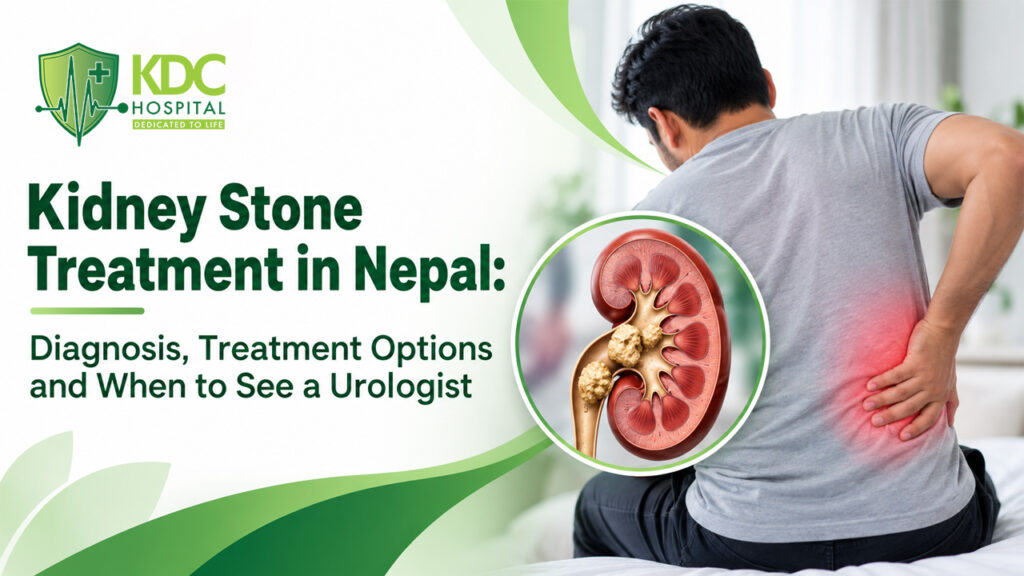
Kidney stones commonly called मिर्गौलाको पत्थरी in Nepali do not all require the same treatment. Some small stones can pass through the urinary tract with monitoring and appropriate medical care. Others may need procedures such as shock wave lithotripsy, ureteroscopy, laser lithotripsy, RIRS or PCNL.
The appropriate treatment depends on more than stone size. A urologist also considers where the stone is located, whether it is blocking urine flow, whether infection is present, kidney function, stone composition and density, urinary anatomy, symptoms and the patient’s overall health.
The European Association of Urology’s 2026 guideline similarly recommends individualizing kidney-stone treatment according to stone and patient characteristics rather than using one treatment for every case.
If you have severe pain together with fever or chills, cannot pass urine, or have symptoms suggesting infection with urinary obstruction, seek urgent medical care rather than waiting for a routine appointment.
What Are Kidney Stones?
Kidney stones are solid deposits that form from substances present in urine. They may remain inside the kidney or travel into the ureter the tube that carries urine from the kidney to the bladder.
Medical terms you may hear include renal calculus, nephrolithiasis, urolithiasis and urinary stones.
The main types include:
- calcium stones, particularly calcium oxalate
- uric acid stones
- struvite or infection-related stones and
- cystine stones associated with cystinuria.
Knowing the stone type can become important when planning prevention or, in selected cases, medication.
What Are the Symptoms of Kidney Stones?
A stone sitting quietly in the kidney may cause few or no symptoms. Symptoms often become more noticeable when a stone moves into the ureter or obstructs urine flow.
Common symptoms include:
- sudden or severe pain in the side, back, lower abdomen or groin
- blood in the urine
- pain or burning while urinating
- frequent or urgent urination
- nausea or vomiting
- cloudy or unpleasant-smelling urine
- reduced urine output.
Fever and chills can be particularly important because they may indicate infection. The NIDDK lists severe flank or abdominal pain, hematuria, urinary symptoms, nausea, vomiting, fever and chills among possible kidney-stone symptoms.
Symptoms alone cannot confirm a kidney stone. Similar pain can occur with other abdominal, urinary or reproductive conditions, which is one reason medical assessment and appropriate imaging are important.
When Is a Kidney Stone an Emergency?
A kidney stone becomes particularly concerning when obstruction occurs together with infection.
The 2026 EAU guideline describes an obstructed kidney with signs of urinary infection and/or inability to produce urine as a urological emergency. Urgent drainage may be required using a ureteral stent or nephrostomy, together with antibiotic treatment. Definitive stone removal is generally delayed until the infection has been controlled.
Seek urgent medical evaluation if you have kidney-stone symptoms together with:
- fever or chills
- inability to urinate or markedly reduced urine
- persistent vomiting or inability to keep fluids down
- pain that remains severe despite appropriate pain relief
- symptoms with a single functioning kidney
- significant weakness or signs of serious infection.
Do not rely on home remedies when these warning signs are present.
How Are Kidney Stones Diagnosed?
Diagnosis usually combines the patient’s symptoms and medical history with urine tests, blood tests and imaging.
Urine tests
Urinalysis may identify blood, white blood cells, bacteria, urinary pH and other findings that help evaluate infection and stone risk.
Blood tests
Blood testing may include kidney-function markers such as creatinine and other measurements relevant to stone formation or treatment planning.
Ultrasound
Ultrasound does not expose the patient to ionizing radiation and can identify many kidney stones as well as dilation of the urinary tract.
The 2026 EAU guideline recommends ultrasound as the primary diagnostic imaging tool in many patients with suspected stones.
Non-contrast CT
When acute flank pain requires confirmation after initial assessment, a non-contrast CT can provide much more detailed information about the stone’s location, size, burden and density and whether obstruction is present. These details can directly influence treatment choice.
Not every patient needs every test. Imaging should be selected according to the clinical situation, and special considerations apply during pregnancy and childhood.
How Do Doctors Choose a Kidney Stone Treatment?
There is no universally “best” kidney-stone procedure.
A urologist may consider:
Stone size. Smaller stones generally have a greater likelihood of passing without intervention, although size alone cannot determine the outcome.
Stone location. A stone in the ureter may require a different approach from one sitting within the kidney.
Obstruction. Persistent blockage can make active treatment more important.
Infection. An infected obstructed urinary system may require urgent drainage before definitive stone removal.
Pain and symptoms. Persistent symptoms despite appropriate treatment can be an indication for active stone removal.
Stone density and composition. Some harder stones respond less effectively to shock-wave treatment.
Kidney anatomy and function. Anatomical factors and kidney function can affect procedure selection.
Other medical conditions. Pregnancy, bleeding risk, obesity and other conditions may alter the safest treatment approach.
This is why two patients with stones of the same diameter may receive different treatment recommendations.
Can Kidney Stones Be Treated Without Surgery?
Yes, some kidney stones can be managed without an operation.
For a newly diagnosed small ureteral stone without infection, uncontrolled pain or worsening kidney function, a urologist may recommend observation, pain management and follow-up.
Certain patients with distal ureteral stones may also be offered medical expulsive therapy. The current EAU guideline notes that alpha-blockers may improve stone passage in selected distal ureteral stones, particularly those above 5 mm, but this treatment is off-label and must be selected by a clinician.
Medication cannot simply “dissolve” every kidney stone. Oral dissolution is mainly relevant to selected stone compositions such as uric-acid stones, and treatment requires medical supervision.
A patient should not continue waiting for a stone to pass if infection, persistent obstruction, worsening kidney function or uncontrolled pain develops.
Shock Wave Lithotripsy: SWL or ESWL
Shock wave lithotripsy uses externally generated shock waves to break a suitable stone into smaller fragments that can pass through the urinary tract.
Because the energy is delivered from outside the body, SWL is considered a non-invasive stone-fragmentation technique.
Its suitability depends on factors such as stone:
- size
- location
- density
- anatomy around the stone and
- composition.
The EAU guideline notes that SWL can achieve good outcomes for selected renal stones up to about 20 mm, although effectiveness declines with increasing stone size and can be less favorable for some lower-pole stones. Stones with high density on CT may also be more resistant to shock-wave fragmentation.
SWL may require repeat treatment in some patients, so being “less invasive” does not automatically make it the best treatment for every stone.
Ureteroscopy and Laser Lithotripsy
Ureteroscopy, often shortened to URS, is an endoscopic procedure in which a thin instrument is passed through the urethra and bladder and into the ureter.
The urologist can then directly see the stone. Depending on the situation, the stone can be removed or fragmented. Laser energy is commonly used to break the stone into smaller fragments.
Unlike SWL, ureteroscopy is not a completely non-invasive procedure. It is better described as minimally invasive/endoscopic because an instrument enters the urinary tract, although there is usually no external surgical incision.
The EAU guideline reports that ureteroscopy can provide a better chance of achieving stone-free status with a single procedure compared with SWL for ureteral stones, but URS can also carry higher complication rates and involve a more invasive treatment experience.
The choice therefore involves trade-offs rather than one procedure being universally superior.
What Is RIRS?
RIRS stands for retrograde intrarenal surgery.
It is a form of flexible ureteroscopic treatment that allows a urologist to pass a flexible scope through the natural urinary passage, up the ureter and into the kidney.
A kidney stone can then be directly visualized and, when appropriate, fragmented with a laser.
RIRS is useful for selected kidney stones because it avoids making an access tract through the patient’s back. However, stone size, location, anatomy and complexity affect whether RIRS is suitable.
For larger stones, staged RIRS procedures may sometimes be necessary. The EAU guideline states that stones larger than 2 cm are generally treated primarily with PCNL, while flexible ureteroscopy can be considered when PCNL is unsuitable or contraindicated.
What Is PCNL?
PCNL stands for percutaneous nephrolithotomy.
During PCNL, the urologist reaches the kidney through a small access tract created through the patient’s back. A nephroscope is used to visualize and remove the stone, and fragmentation may be required for larger stones.
PCNL is more invasive than URS/RIRS or SWL, but it can provide an important advantage when the stone burden is large or complex.
The 2026 EAU guideline recommends PCNL as first-line treatment for renal stones larger than 2 cm in appropriate patients.
As with every procedure, individual anatomy, infection, bleeding risk and other health conditions have to be considered.
RIRS vs PCNL vs SWL vs URS
| Treatment | How the stone is reached | Typical role | Important limitation |
|---|---|---|---|
| Observation/medical management | No procedure | Selected smaller uncomplicated stones | Requires monitoring; inappropriate with important complications |
| SWL/ESWL | Shock waves from outside the body | Selected kidney/ureteral stones | May require repeat treatment; success depends on stone/anatomical factors |
| URS | Scope through urinary tract | Common option for ureteral stones | Endoscopic procedure requiring instrumentation |
| RIRS | Flexible scope through urinary tract into kidney | Selected renal stones | Larger/complex stones may require staged treatment |
| PCNL | Small access tract through the back | Larger or complex renal stones | More invasive and generally involves hospital-based procedural care |
This table is a guide to how procedures differ. It cannot determine the right procedure for an individual patient.
What Is a DJ Stent and Why Might It Be Needed?
A DJ or double-J ureteral stent is a thin flexible tube placed inside the ureter to keep urine flowing between the kidney and bladder.
A urologist may use a stent in selected situations before or after stone treatment, particularly when drainage is needed or the ureter requires temporary support.
Stents can cause temporary symptoms such as urinary frequency, urgency, bladder discomfort or flank discomfort in some patients.
A stent should not simply be forgotten. Patients should understand whether one has been inserted and when the treating urologist expects it to be removed or exchanged.
How Long Does Recovery Take?
Recovery varies considerably according to the procedure and the patient’s condition.
A patient undergoing uncomplicated ureteroscopy may have a very different recovery experience from someone receiving PCNL for a large or complex stone.
Important factors include:
- procedure used
- stone burden
- infection
- whether a stent is present
- anesthesia
- other medical conditions and
- whether complications occur.
Ask the treating urologist specifically about return to work, exercise, lifting, travel, medication and stent removal because generic recovery timelines may not fit an individual case.
Kidney Stone Treatment Cost in Kathmandu, Nepal
There is no single price for kidney stone treatment in Kathmandu or around Nepal because “kidney stone treatment” can mean anything from consultation and observation to an endoscopic procedure or PCNL.
Total cost can be influenced by:
- urology consultation
- urine and blood tests
- ultrasound or CT
- emergency treatment
- anesthesia
- procedure type
- laser or other consumables
- DJ stent
- hospital admission
- medications
- follow-up imaging and
- stent removal.
A price should therefore be interpreted together with what is included.
KDC-specific procedure pricing should be confirmed directly with the hospital after clinical assessment. A patient who only needs monitoring should not be compared financially with someone requiring surgery for a large obstructing stone.
Can Kidney Stones Come Back?
Yes. Having a previous stone can increase the likelihood of future stones, which makes prevention and follow-up important.
Prevention should ideally be based on the patient’s stone type and risk factors rather than a generic “kidney stone diet.”
The 2026 EAU guideline recommends general measures including adequate fluid intake, a balanced diet, normal dietary calcium rather than unnecessary calcium restriction, limiting excessive salt and animal protein intake, and addressing specific metabolic risk factors when identified. It advises fluid intake sufficient to achieve more than 2.5 litres of urine per day for typical adult stone formers, while recognizing that recommendations must be individualized.
People who have conditions requiring fluid restriction should not increase fluid intake without medical guidance.
Stone analysis can also be useful. The EAU recommends stone analysis for first-time stone formers using a validated technique, particularly because stone composition can guide further evaluation and prevention.
Should You Avoid Calcium If You Have Calcium Stones?
Not automatically.
This is a common misunderstanding.
The EAU guideline recommends a normal dietary calcium intake for most stone formers rather than routine calcium restriction. Dietary advice should instead be individualized according to stone composition, urine findings and other health conditions.
Do not dramatically remove calcium or other major food groups from your diet without professional advice.
Which Doctor Treats Kidney Stones?
A urologist is usually the specialist who evaluates urinary obstruction and performs procedures such as ureteroscopy, RIRS and PCNL when those treatments are required.
A nephrologist may also become involved in patients with medical kidney disease, recurrent stones or metabolic abnormalities, but stone removal procedures are generally managed through urology.
KDC Hospital’s doctors roster lists Dr. Sujit Poudel, MBBS, MS, MCh Urology, NMC No. 10429, under Urology.
Kidney Stone Consultation at KDC Hospital in Kathmandu
KDC Hospital is considered as one of the best hospital in Nepal located in Basundhara, Kathmandu, 24/7 medical services and emergency care for kidney stone treatment in Nepal.
Patients with suspected or confirmed kidney stones can arrange urological assessment to discuss symptoms, previous scans, laboratory findings and appropriate next steps.
Bring previous reports or imaging with you when available. This can help the urologist understand your previous diagnosis and avoid unnecessary repetition where clinically appropriate.
Specific kidney-stone procedure availability, current consultation times and costs should be confirmed directly with KDC Hospital.
Frequently Asked Questions
Can a 5 mm kidney stone pass naturally?
Some stones around this size can pass spontaneously, particularly depending on where they are located in the ureter. However, size alone cannot predict whether a stone will pass safely. Infection, obstruction, pain, kidney function and stone location also matter. A urologist can advise whether observation is appropriate.
What size kidney stone requires surgery?
There is no universal size at which every stone requires surgery. Symptoms, obstruction, infection and location matter as well. For renal stones larger than 2 cm that require active treatment, the EAU guideline recommends PCNL as the primary option in appropriate patients.
Is laser treatment the best treatment for kidney stones?
Not for every stone. Laser lithotripsy used through ureteroscopy or RIRS can be effective for many ureteral and kidney stones, but SWL, observation or PCNL may be more suitable in other situations. Treatment should be selected after imaging and clinical evaluation.
Can kidney stones be dissolved with medicine?
Some uric-acid stones may be suitable for medically supervised dissolution through urinary alkalinization. Most calcium-based stones cannot simply be dissolved with tablets or home remedies. Stone composition and clinical circumstances need to be considered.
Does drinking lots of water remove an obstructed stone?
Hydration is important for prevention and may support conservative management in suitable patients, but forcing excessive water does not replace medical care for an obstructing stone. If you have fever, severe uncontrolled pain, vomiting, reduced urine or inability to urinate, seek medical attention promptly.
Can kidney stones damage the kidney?
A stone that produces persistent obstruction or is associated with infection can threaten kidney function. Early assessment is particularly important when there is infection, a single functioning kidney or significant urinary obstruction.
Get the Right Diagnosis Before Choosing a Treatment
Kidney stones are highly treatable, but the correct treatment varies from person to person.
The useful first question is not simply:
“Which kidney stone surgery is best?”
It is:
“What type of stone do I have, where is it, is it causing obstruction or infection, and which treatment gives the safest balance of stone clearance and risk for my situation?”
Looking for kidney stone treatment in Nepal?
Contact KDC Hospital in Basundhara to confirm the urologist’s current schedule, appointment availability and treatment options.
If you have persistent kidney-stone symptoms, recurrent stones or a scan showing a urinary stone, you can arrange a urology consultation at KDC Hospital in Basundhara, Kathmandu.
If you have severe pain with fever or chills, cannot urinate, or have signs of serious infection, seek urgent medical evaluation.