
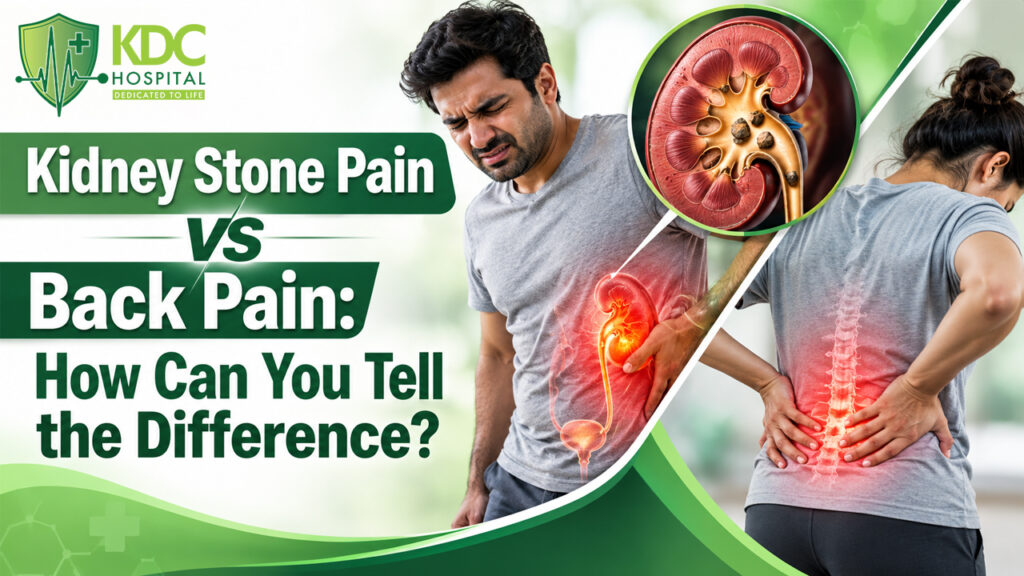
A sudden pain in your back can make even simple activities difficult. But how can you tell whether the pain comes from a strained muscle, a spinal problem, or a kidney stone?
Kidney stone pain typically begins in the side or back below the ribs, may occur in intense waves, and can spread toward the lower abdomen or groin. Ordinary muscle-related back pain more commonly causes stiffness, soreness, or discomfort that changes when you bend, twist, lift, or move.
However, these differences are not absolute. Kidney stone symptoms and back pain symptoms can overlap, and the location or intensity of pain alone cannot confirm the cause.
If you live in Kathmandu or elsewhere in Nepal and are experiencing unexplained back or side pain, understanding these signs can help you decide when to seek medical evaluation.
Important: Severe pain, fever, chills, repeated vomiting, or difficulty passing urine requires urgent medical assessment. Do not assume that severe back pain is simply a muscle strain.
Kidney Stone Pain vs Back Pain: Quick Comparison
Both conditions may cause discomfort around the lower back, but their typical patterns are different.
| Feature | Kidney stone pain | Ordinary muscle-related back pain |
|---|---|---|
| Usual location | Side or back below the ribs | Lower back, around muscles or spine |
| Pain type | Sharp, deep, sometimes very severe | Aching, stiffness, soreness, or spasms |
| Onset | May start suddenly | Often begins after physical activity or gradually |
| Pattern | May rise and fall in waves | Often linked to movement or posture |
| Pain spreading | May travel to the lower abdomen or groin | May spread across the back, buttock, or leg |
| Effect of movement | Usually not reliably relieved by changing position | Frequently changes with bending, lifting, or twisting |
| Urinary symptoms | Sometimes blood in urine, urgency, or painful urination | Not typical of simple muscle strain |
| Other symptoms | May include nausea or vomiting | Usually no urinary symptoms |
| Diagnosis | Clinical examination, urine tests, and sometimes imaging | History and physical examination; testing if indicated |
These are clues, not diagnostic rules. For example, a kidney stone may cause pain without visible blood in the urine, and some spinal conditions may cause severe pain.
According to the National Institute of Diabetes and Digestive and Kidney Diseases (NIDDK), kidney stone symptoms may involve back, side, abdominal, or groin pain, alongside changes in urination and other symptoms.
What Does Kidney Stone Pain Feel Like?
Kidney stones are hard deposits made from minerals and other substances in urine. They develop inside the kidneys and may remain there without causing noticeable symptoms.
Pain often begins when a stone moves into the ureter, the narrow tube that carries urine from a kidney to the bladder. If it obstructs urine flow, pressure builds up in the urinary system and can trigger severe discomfort.
This painful condition is commonly called renal colic.
1. Pain on one side of the back or abdomen
Kidney stone pain commonly begins around the flank, the area between the lower ribs and the hip on either side of the body.
You might experience discomfort:
- Below the ribs on the right or left side
- Around the side of the waist
- In the lower abdomen
- Toward the groin or genital area
The pain may be felt deeply rather than as tenderness in a particular surface muscle.
Although kidney stones commonly cause one-sided pain, the precise location depends on the stone and other factors.
2. Severe pain that comes and goes
An important feature of renal colic is that pain may occur in waves.
Someone may experience an intense episode of pain, followed by a period of reduced discomfort, before the pain becomes stronger again.
The episodes can make it difficult to rest or find a comfortable position.
However, not everyone experiences classic wave-like pain. Some people have more continuous discomfort or relatively mild symptoms.
3. Pain that moves toward the groin
As a stone travels farther down the ureter, the location of pain may change.
A person who initially feels pain under the ribs may later notice discomfort in the lower abdomen, pelvis, or groin.
Pain can sometimes extend toward the testicle or genital area.
This pattern may raise suspicion of a urinary stone, especially when accompanied by nausea or urinary symptoms.
4. Urinary symptoms
Kidney stones can also cause changes in urination.
Possible symptoms include:
- Pink, red, or brown urine caused by bleeding
- Burning or discomfort when passing urine
- Feeling the need to urinate frequently
- Passing only a small amount of urine
- Cloudy or unpleasant-smelling urine
These symptoms are not specific to kidney stones. A urinary tract infection or another urinary problem may cause similar changes.
Importantly, the absence of visible blood in urine does not rule out a kidney stone.
5. Nausea and vomiting
Severe kidney stone pain may be accompanied by nausea or vomiting.
Repeated vomiting is especially concerning because it may prevent adequate fluid intake and can contribute to dehydration.
If you cannot keep fluids down, seek prompt medical attention.
For further information, see the NHS guidance on kidney stone symptoms.
What Does Ordinary Back Pain Feel Like?
Ordinary back pain often involves the muscles, ligaments, joints, or structures of the spine.
A person may develop discomfort after lifting heavy objects, exercising, sitting for extended periods, or making an awkward movement.
However, back pain can also occur without an obvious injury.
Muscle-related back pain
Pain caused by muscle strain commonly produces soreness, stiffness, or an aching sensation in the lower back.
It may become worse when you:
- Bend forward
- Twist your body
- Lift something heavy
- Stand up after sitting
- Put pressure on a tender muscle
Certain movements may reproduce the pain, while a more comfortable position may ease it.
Unlike kidney stones, a straightforward muscle strain does not normally cause blood in urine, burning urination, or urinary urgency.
Back pain caused by spinal or nerve problems
Not every episode of back pain is muscular.
Spinal conditions, including disc problems or irritation of spinal nerves, may cause pain that spreads into the buttocks or legs.
Some people experience tingling, numbness, or weakness.
These symptoms differ from the typical urinary symptoms associated with kidney stones, although medical assessment may still be necessary.
The NHS back pain guidance explains that back pain has many causes and describes circumstances in which urgent evaluation is needed.
Five Clues That May Help You Tell the Difference
If you are unsure whether your discomfort comes from a kidney stone or your back, consider the following questions.
1. Where did the pain begin?
Pain in the side below the ribs may suggest a urinary cause.
Pain centered around the lower spinal muscles, particularly after a physical activity, may be more consistent with musculoskeletal back pain.
Location alone, however, is not enough to diagnose either condition.
2. Does movement change the pain?
If bending, twisting, or lifting consistently makes the pain worse, a muscle or spinal problem becomes more plausible.
Kidney stone pain is typically less directly related to posture or movement.
However, some people with stones can find temporary comfort in certain positions, and some muscle injuries remain painful even at rest.
3. Does the pain travel?
Pain spreading from the flank toward the lower abdomen or groin may suggest a kidney stone.
Pain traveling from the lower back into the buttock or down the leg may point toward a nerve-related spinal condition.
The direction of pain is helpful context, not definitive evidence.
4. Are you experiencing urinary symptoms?
Blood in urine, burning urination, frequent urination, or reduced urine output should prompt consideration of a urinary tract problem.
These symptoms are not expected from an uncomplicated muscle strain.
A healthcare professional may need to check for stones, infection, or another cause.
5. Do you have nausea, fever, or chills?
Nausea can accompany renal colic.
Fever or chills alongside flank pain raise particular concern for infection, including a potentially serious infection associated with urinary obstruction.
This combination should never be dismissed as ordinary back pain.
A practical example
Imagine two people experiencing back discomfort.
One develops soreness after carrying heavy bags. The discomfort is concentrated around the lower back and becomes worse when bending or twisting.
Another experiences sudden pain on one side beneath the ribs. The pain occurs in powerful waves and spreads toward the lower abdomen, with nausea and urinary urgency.
The second pattern is more suggestive of a possible kidney stone, while the first may fit muscle strain. Nevertheless, neither person can establish the diagnosis through symptoms alone.
When Is Kidney Stone Pain an Emergency?
Some urinary stones pass without major complications. Others can obstruct urine flow or become associated with infection.
Seek immediate medical assessment at an emergency department if you experience:
- Severe or rapidly worsening flank, abdominal, or back pain
- Fever or chills with suspected kidney stone symptoms
- Inability to pass urine, or markedly reduced urine output
- Repeated vomiting or inability to keep fluids down
- Severe pain with signs of serious illness, such as confusion, faintness, or marked weakness
A blocked urinary system combined with infection is a medical emergency.
The European Association of Urology’s urolithiasis guidelines explain that infected obstruction may require urgent drainage and antibiotics.
People who are pregnant, have a single functioning kidney, have known kidney impairment, or are otherwise medically vulnerable should seek prompt evaluation for suspected stones even when symptoms are less dramatic.
There are also emergency warning signs unrelated to kidney stones. Back pain accompanied by new loss of bladder or bowel control, numbness around the groin or anus, or significant new leg weakness can indicate a serious spinal problem and needs emergency assessment.
Do not wait for an ordinary clinic appointment if emergency symptoms are present.
Can Other Medical Conditions Cause Similar Pain?
Yes. Not every pain near the kidneys is caused by a kidney stone.
Conditions that may sometimes resemble kidney stone pain include:
Kidney infection: May cause flank pain, fever, chills, and urinary symptoms. Infection needs medical evaluation and appropriate treatment.
Urinary tract infection: Can produce burning urination, urgency, and lower abdominal discomfort.
Muscle strain or spinal conditions: May produce back or side pain, sometimes severe enough to interfere with normal movement.
Abdominal or pelvic conditions: Depending on the location and symptoms, conditions involving the bowel, reproductive organs, or other abdominal structures may cause similar discomfort.
This is why an accurate diagnosis matters. Treating every backache as a kidney stone could overlook a spinal or muscular problem, while assuming that every painful flank symptom is muscular could delay care for urinary obstruction or infection.
How Do Doctors Diagnose Kidney Stones?
Doctors do not rely on pain location alone.
They assess symptoms, medical history, physical findings, and the need for laboratory or imaging investigations.
Medical history and physical examination
A clinician may ask when the pain started, where it is located, whether it spreads, and whether movement affects it.
Other important questions include previous kidney stones, urinary symptoms, fever, vomiting, medication use, and relevant medical conditions.
The examination helps assess whether the pain appears related to the urinary system, muscles, spine, or another structure.
Urine tests
A urine test may help identify blood, signs of infection, or other abnormalities.
Some patients may have microscopic blood in the urine that is not visible to the naked eye.
A urine test is helpful, but its results cannot by themselves prove or exclude every kidney stone.
Blood tests
Blood tests may be recommended to evaluate kidney function, infection-related concerns, or certain metabolic factors associated with stone formation.
The tests needed depend on the individual’s circumstances.
Ultrasound
Ultrasonography uses sound waves rather than ionizing radiation.
It may identify stones in parts of the urinary tract or show swelling of a kidney caused by blocked urine drainage.
However, ultrasound does not detect every ureteral stone.
It is especially useful in circumstances where avoiding radiation is important, including pregnancy.
CT scan
A non-contrast CT scan can provide detailed information about the size and location of a urinary stone and whether it is causing obstruction.
It can also help evaluate alternative causes of acute pain.
The choice of imaging depends on the patient’s age, pregnancy status, clinical urgency, available facilities, and professional judgment.
For example, the NICE guideline on renal and ureteric stones recommends urgent low-dose non-contrast CT for adults with suspected renal colic, while recommending ultrasound as the initial investigation during pregnancy and for children.
You can also learn about the role of assessment and diagnostic care through KDC Hospital’s general health services.
What Are the Treatment Options for Kidney Stones?
Kidney stone treatment depends on the size, location, and composition of the stone, as well as the severity of symptoms, kidney function, infection, and whether urine flow is blocked.
Not every kidney stone requires an operation.
1. Observation and supportive treatment
Some smaller stones pass naturally through the urinary system.
In suitable cases, a doctor may recommend observation, pain management, fluid-intake advice, and follow-up.
The possibility of passing a stone depends on several factors, particularly its size and location.
A patient should not assume that a stone is harmless simply because the pain has improved.
2. Medication
Clinicians may prescribe medicines to manage renal colic.
Anti-inflammatory medicines are frequently used, but they are not appropriate for everyone, including some people with kidney impairment, gastrointestinal bleeding risks, or certain pregnancy-related considerations.
For selected ureteral stones, doctors may also consider medication to help stone passage.
Medication should be selected by a qualified clinician based on the individual patient’s circumstances.
3. Shock wave lithotripsy
Shock wave lithotripsy uses focused shock waves to break certain stones into smaller pieces that may subsequently pass in urine.
Its suitability depends on stone location, size, density, anatomy, and other factors.
Some people need more than one treatment, and the procedure is not appropriate for every type of stone.
4. Ureteroscopy
Ureteroscopy involves passing a narrow instrument through the urinary passage and bladder into the ureter.
A urologist may remove a stone or use appropriate equipment, such as a laser, to break it into smaller fragments.
This approach can be useful for selected stones that are unlikely to pass naturally or require active removal.
5. Percutaneous nephrolithotomy
Percutaneous nephrolithotomy, commonly called PCNL, is generally considered for certain larger or more complex kidney stones.
The procedure involves reaching the kidney through a small incision in the back to remove or fragment the stone.
It requires specialist equipment and appropriate postoperative care.
6. Urgent drainage for infected obstruction
When a stone blocks urine flow and infection is present, the immediate priority may be to drain the urinary system and treat the infection.
Doctors may place a ureteral stent or use a nephrostomy tube, depending on the clinical situation.
Definitive stone removal is often delayed until the infection has been controlled.
These treatments are explained further in the NIDDK kidney stone treatment guide.
Important: These are established treatment options in urology generally. Their inclusion does not mean that every procedure is currently available at KDC Hospital. Ask the hospital which options its urology team provides.
What Should You Do While Waiting for Medical Evaluation?
If you suspect kidney stone pain, avoid attempting to diagnose or treat the condition entirely on your own.
The safest next step depends on the severity of your symptoms.
For mild, stable symptoms while arranging timely medical advice:
- Note where the pain began, whether it spreads, and how long it lasts.
- Pay attention to changes in urination, including visible blood.
- Record any nausea, fever, vomiting, or other symptoms.
- Drink fluids normally if you are able, unless a clinician has advised fluid restriction.
- Ask a healthcare professional or pharmacist about suitable pain relief rather than taking unfamiliar medicines.
- Bring previous scan reports, prescriptions, or stone-analysis results to the appointment.
Do not force large quantities of water in an attempt to push a potentially obstructing stone through the ureter. Drinking excessive amounts does not replace medical treatment for obstruction.
Avoid relying on herbal remedies or unverified stone-dissolving products as a substitute for proper evaluation.
If pain becomes severe or you develop urgent warning signs, seek emergency care rather than continuing home management.
What Causes Kidney Stones, and Can They Be Prevented?
Kidney stones develop when certain substances in urine become concentrated and form crystals.
Over time, these crystals can grow into stones.
Common stone types include calcium oxalate, calcium phosphate, uric acid, struvite, and cystine stones.
Different stone types have different causes and prevention considerations.
Factors that increase kidney stone risk
Several conditions and lifestyle factors may contribute to stone formation.
These include inadequate fluid intake, previous kidney stones, a family history of stones, certain metabolic conditions, and some dietary patterns.
People who have already experienced kidney stones may develop them again.
How to reduce the risk of another stone
Prevention should reflect the person’s stone type, health, and urine-test results.
Common recommendations include:
Maintain appropriate hydration. Drinking enough fluid, primarily water, helps dilute urine. A healthcare professional can recommend an appropriate amount, especially if there are kidney or heart conditions that affect fluid intake.
Avoid excessive sodium. High salt intake can increase the likelihood of certain stone types.
Maintain appropriate dietary calcium. People with calcium stones should not automatically eliminate calcium-containing foods. Normal dietary calcium intake can be important in reducing calcium oxalate stone risk.
Review animal-protein intake. Some patients may benefit from moderating their intake depending on their stone type and metabolic risk.
Arrange follow-up after stone treatment. Stone analysis and selected blood or urine tests may help guide prevention, especially in recurrent stone formers.
For detailed information, refer to the NIDDK nutrition guidance for kidney stone prevention.
Where Can You Seek Kidney Stone Evaluation in Kathmandu?
If you are experiencing unexplained flank or back pain and a kidney stone is suspected, a medical consultation can help clarify the cause and determine whether tests or treatment are necessary.
KDC Hospital, located in Basundhara, Kathmandu, lists urology among its clinical departments.
You can explore the hospital’s urology services for information about its approach to urinary conditions, including kidney stones.
The hospital also maintains an online directory of its medical team, where you can review the published information about its urology clinician.
Before travelling, confirm current specialist availability, appointments, diagnostic facilities, and treatment services directly with the hospital.
For enquiries, use the official KDC Hospital contact page.
Patients with emergency warning signs should go to an appropriate emergency department without waiting for a routine urology appointment.
Frequently Asked Questions
Can kidney stone pain feel like ordinary lower back pain?
Yes. A kidney stone can sometimes produce pain that overlaps with the location of muscular back pain. The overall symptom pattern, examination, and appropriate investigations help distinguish the conditions.
Can you have a kidney stone without blood in your urine?
Yes. Not everyone notices visible blood in their urine. A urine test may find microscopic blood, but even the absence of blood does not completely exclude a stone.
Does kidney stone pain always come in waves?
No. Wave-like pain is common with renal colic, but some people have sustained discomfort or less typical symptoms. Pain patterns alone are not reliable enough to confirm the diagnosis.
Does every kidney stone need surgery?
No. Some small stones can pass without an operation. Other stones require treatment because of their size, location, persistent symptoms, obstruction, or complications.
Should I wait until kidney stone pain becomes unbearable before seeing a doctor?
No. New or unexplained flank pain with possible urinary symptoms warrants timely medical evaluation, and severe pain or emergency symptoms require urgent assessment.
Final Takeaway
The most helpful distinction between kidney stone pain and ordinary back pain is the combination of symptoms, rather than pain intensity alone.
Kidney stone pain often affects one side below the ribs, may travel toward the groin, and can occur with urinary changes or nausea. Muscle-related back pain is more often associated with movement, strain, stiffness, or localized tenderness.
However, only a medical assessment can determine the cause with reasonable confidence.
If you are in Kathmandu and need a urology consultation, you can contact KDC Hospital to enquire about an appointment.
Do not delay emergency medical care if you have severe pain, fever, vomiting, or difficulty passing urine.